
Your Dog Might Not Be Just ‘Chubby,’ But Obese: How to Check Obesity Levels at Home
Magentalab Research Team
August 4, 2026
Hello, pet parents! I am Ansim-i, a Dachshund and Chief Researcher who studies day and night for the health of our cute dogs and cats. I am happy to greet you again today!
Have you recently looked at your furry friends and smiled, thinking, “Oh my, my baby looks so cute with a little extra chub!”? It is true that their round, soft bodies are incredibly adorable. However, speaking objectively as a researcher, that “cute chubbiness” might actually be a sign of “obesity” that puts a heavy burden on their joints and heart! Today, let’s accurately diagnose your pet’s body condition together with Ansim-i and take the first step toward a healthier life.

1. Why Do Our Pets Gain Weight? Analyzing the Causes of Obesity
It is natural for pet parents to feel full just by watching their pets eat, but there are clear scientific reasons why their weight increases. Let me point out three major causes!
First, they consume more calories than they burn!
This is the simplest and clearest law of physics. The treats you give them frequently outside of their regular meals, or that tiny piece you share when you are eating, can easily turn into a binge that far exceeds their recommended daily calorie intake!
Second, hormonal changes due to spaying/neutering and aging!
After spaying or neutering, the secretion of sex hormones decreases, leading to an approximate 20-25% drop in their basal metabolic rate. This means their bodies change to gain weight more easily even if they eat the exact same amount. The natural decrease in activity levels as they age is also a significant factor.
Third, genetic factors and breed characteristics!
Breeds like Retrievers, Cocker Spaniels, and long-backed Dachshunds like me are genetically predisposed to have a big appetite and are more prone to obesity. Among cats, British Shorthairs and Domestic Shorthairs tend to get chubby easily!

2. Ideal Weight vs. Overweight vs. Obese: How Do We Tell the Difference? (BCS Criteria)
| Body Condition (BCS) | Waist and Abdomen Appearance (Top/Side View) | Rib Palpation Feel (Compared to Your Hand) | Major Critical Risk Factors by Breed |
| Ideal (BCS 4-5) | Smooth curve at the waist / Abdomen is firmly tucked up | Ribs are easily felt under a slight fat covering, like touching the back of your hand | None (Safe zone) |
| Overweight (BCS 6-7) | Waistline is invisible and straight / Abdomen begins to sag | Ribs are difficult to find and can only be felt by pressing firmly | Rapid worsening of luxating patella in small breeds (Maltese/Pomeranian, etc.) |
| Obese (BCS 8-9) | Waist bulges outward like a barrel / Abdomen sags heavily | Only a thick layer of fat is felt, like touching your palm; bones are impossible to feel | 4 to 5 times higher risk of Intervertebral Disc Disease (IVDD) in Dachshunds/Corgis, and diabetes in cats |
When measuring your pet’s obesity level, we do not judge solely by the number on the scale, but we use a globally accepted standard called the Body Condition Score (BCS). It is usually divided into a 9-point scale, with 4 to 5 considered the most ideal “normal body condition.”
Ideal Body Condition (BCS 4-5)
When viewed from above, a gentle curve (a slight inward dip just behind the ribs) is visible at the waist. When viewed from the side, the abdomen has a nice upward tuck. When you touch the ribs, they can be easily felt beneath a thin layer of fat.
Overweight (BCS 6-7)
When viewed from above, the waistline is almost invisible and straight. When viewed from the side, you can start to notice a sagging abdomen. When palpating, it is a bit difficult to find the ribs, and you can only feel them by applying firm pressure.
Obese (BCS 8-9)
When viewed from above, the waist actually bulges outward, taking on a barrel shape. From the side, the belly is sagging heavily downwards! You can also feel thick layers of fat at the base of the neck and tail, and it is extremely difficult to feel the ribs no matter how hard you press.

3. The ‘Rib Palpation Method’ You Can Do in 3 Seconds at Home
You do not need to come all the way to the clinic! Let me teach you the most reliable and scientific self-diagnosis method you can try at home right now. It is called the “Rib Palpation Method.”
The method is very simple. While your pet is standing comfortably, lightly place both palms on the sides of their chest and gently sweep back and forth. Compare the sensation at your fingertips to the following:
-
If it feels like the back of your hand (Ideal): Just like when you touch the bones on the back of your own hand, if the ribs are slightly covered but their shape can be clearly felt, it is a very ideal normal body condition!
-
If it feels like your palm (Overweight to Obese): If you only feel a thick fleshy cushion like touching your palm and cannot feel the firmness of the bones at all, there is a very high probability that they are currently overweight or obese!

4. Obesity Precautions by Dog and Cat Breeds (Essential if they have a long back like me!)
Because body shapes and bone structures vary, the fatal risks brought by obesity also differ by breed.
Breeds with long backs, like Dachshunds and Welsh Corgis
Obesity is absolutely critical for my fellow Dachshunds! Even a 1 kg weight gain multiplies the pressure on the spine, which can lead to Intervertebral Disc Disease (IVDD) or paralysis. Since there is a strict limit to what our bones can handle, you must keep us slim no matter what!
Small breeds, like Pomeranians and Maltese
For our small dog friends with thin, delicate legs, becoming overweight rapidly worsens patellar luxation (where the kneecap slips out of place). Please be careful, as they could end up suffering from chronic osteoarthritis!
Cats (Especially indoor cats)
Since cats are territorial animals, they tend to have lower activity levels and are prone to obesity. Obese cats develop insulin resistance, making their risk of diabetes mellitus a whopping 4 to 5 times higher than that of normal cats! Also, they may develop skin conditions because they cannot groom themselves properly!

5. Emergency SOS Diet Signals Your Pet is Sending!
Our pets, who cannot speak, are crying out through their body language and behaviors, “My body feels too heavy right now!” If you observe the following signals, you must start a diet immediately.
-
They pant heavily and sit down after just a short walk, or get tired unusually easily.
-
They groan when getting up from a lying position, or their movements are slow and sluggish.
-
Fat folds around their neck and back make it difficult for them to groom or scratch themselves.
-
Their snoring has become noticeably louder, or their breathing is irregular while sleeping.
Dear pet parents! Pet obesity is not simply a cosmetic issue; it is a disease that causes chronic inflammation and shortens their lifespan. Please use the method Ansim-i shared today to thoroughly feel your pet’s body. A healthy diet will add years of happy time for us to spend together. Ansim-i will always support the healthy lives of you and your pets!

Recommended Research Data 🕸️
“Reducing Food Made It More Dangerous!” The Secret to Pet Weight Loss Revealed by Ansim-i
This Daily Habit Can Ruin Your Dog’s Kneecaps: The Truth About Sofa Jumping and How to Prevent It
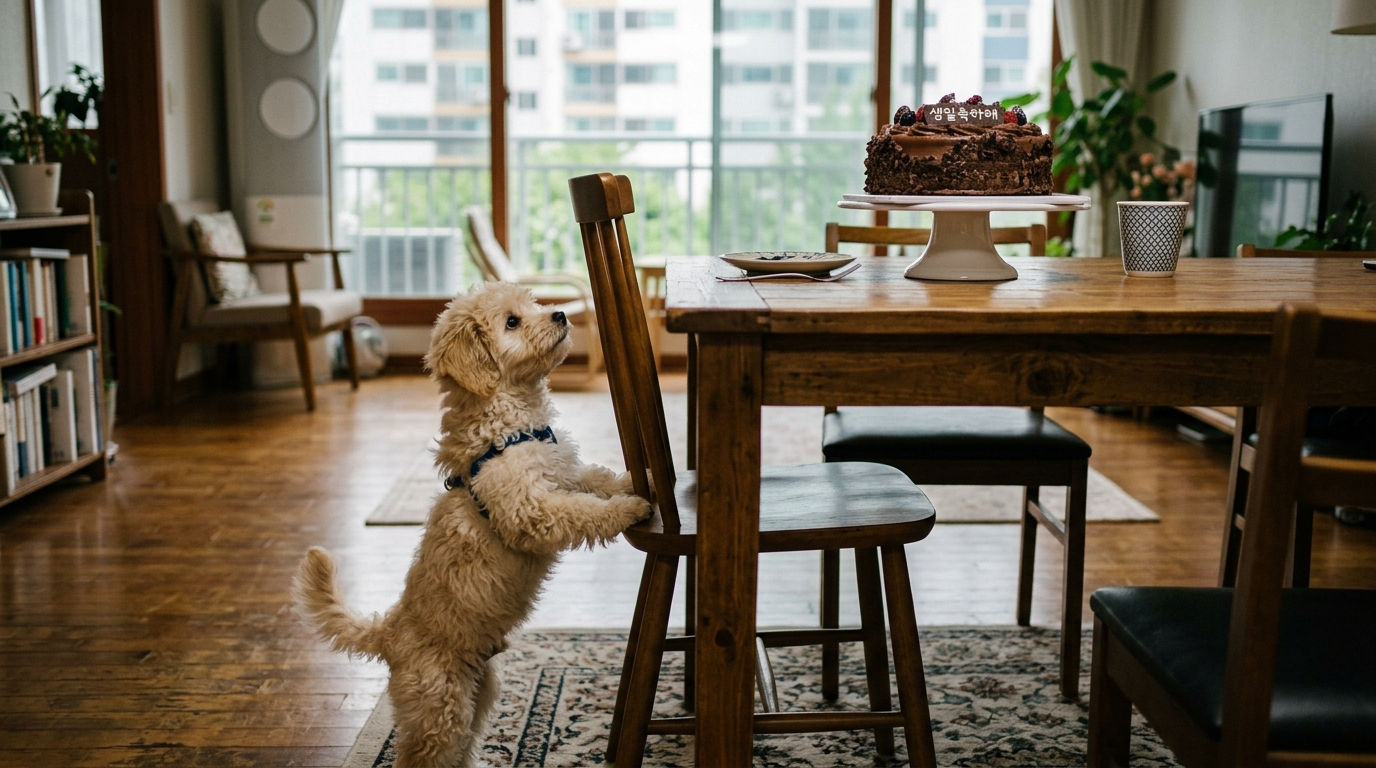
What to Do When Your Dog Eats Chocolate: Why It Is Dangerous and When to Visit the Vet
Comments (0)
No comments yet. Be the first to leave one!