
Tips to Increase Your Cat’s Water Intake & Emergency Encyclopedia of Fatal Nephrotoxic Substances During Dehydration
Magentalab Research Team
July 18, 2026
Hello! I am Ansim-i, a Dachshund and the Chief Researcher at Magentalab Pet Research Institute. Today, to ensure a happy and healthy journey for you and your cat, I am providing an informative veterinary research report.
Today’s topic addresses the eternal homework of cat owners: “Tips to Increase Your Cat’s Water Intake” and the toxic mechanisms of hazardous substances that deal a fatal blow to the kidneys during dehydration. Cats are inherently insensitive to thirst and do not drink enough water on their own. This serves as a primary cause of chronic renal failure and Feline Idiopathic Cystitis (FIC).
1. Evolutionary Reasons Why Cats Do Not Drink Water
The ancestors of modern cats were African wildcats, which adapted to desert environments. As a result, they developed an advanced kidney capacity to concentrate and excrete urine; however, the trade-off is an insensitivity to thirst. Modern cats that consume only dry kibble easily fall into a state of chronic dehydration, often failing to consume even half of their daily required water intake.

2. Kidney Filtration Limits in Dehydration and the Mechanism of Uremia
When the body becomes chronically dehydrated, blood volume decreases, and the blood flow to the kidney glomeruli drops sharply. This destroys the glomerular nephron cells—the core filtration units of the kidneys—preventing the excretion of nitrogenous wastes (like BUN and creatinine) from the blood. The accumulation of these wastes in the body induces a condition called “Uremia.” If nephrotoxic substances enter the body during this dehydrated state, the organ’s filtration system is completely destroyed, leading directly to fatal shock.

3. Comparison of Hazardous Substances that Exacerbate Dehydration and Toxicity Symptoms
The following is a guideline identifying fatal substances that instantly paralyze renal tubules or induce systemic poisoning if ingested while a cat is dehydrated, along with their clinical symptoms. Please frequently check the structured scale table below.
| Kidney Hazard Category | Toxic Agents | Internal Medical Toxicity Mechanism | Early Clinical Toxicity Symptoms | Researcher Ansim-i’s Emergency Home Care Prescription (MEMO) |
| Salt & Sodium | Salt, processed human food | A rapid rise in extracellular fluid osmotic pressure leads to brain cell shrinkage and exceeds the kidney’s osmotic regulation limits. | Induces severe thirst, acute vomiting, diarrhea, systemic seizures, hind limb paralysis. | Strictly forbid feeding human foods high in sodium and provide plenty of clean water immediately. |
| Grapes & Raisins | Tartaric acid | Induces acute necrosis of the epithelial cells in renal glomeruli and tubules, blocking urine output. | Vomiting within hours of ingestion, systemic lethargy, rapid worsening of uremia. | Even a small amount reaches a lethal dose; induce vomiting immediately upon witnessing and initiate 24-hour IV fluid therapy. |
| Lily Plants | Unknown water-soluble toxins | Contact with pollen, leaves, or stems permanently paralyzes the kidney’s filtration function. | Acute vomiting, lethargy, sudden drop in urine output (entering anuria). | Completely remove all lily plants from the home; visit an emergency vet immediately even if only one leaf is touched. |
| Ethylene Glycol | Car antifreeze leaks | Metabolizes to form oxalates, precipitating calcium oxalate crystals in the kidneys and causing glomerular necrosis. | Staggering (similar to drunkenness), vomiting, signs of coma shock. | Administer an antidote and IV fluids within the golden hour immediately after ingestion; initiate hemodialysis if necessary. |

4. Practical Tips to Increase Water Intake for Cats Who Do Not Drink
-
Essential combination with high-moisture wet food: While regular dry kibble contains less than 10% moisture, complete-diet wet food holds a massive 75~80% moisture. Simply switching one meal a day to a wet diet, or mixing lukewarm water into canned wet food, can safely and dramatically satisfy their daily hydration requirements.

-
Independent placement and reorganization of water bowls: Due to their physical instincts, cats tend to avoid drinking water if their food bowl and water bowl are placed right next to each other, as they perceive the water as contaminated by the food. Place multiple water bowls made of materials cats prefer—like glass or ceramic—in independent locations throughout the house, at least 1.5 meters away from their food bowls.

-
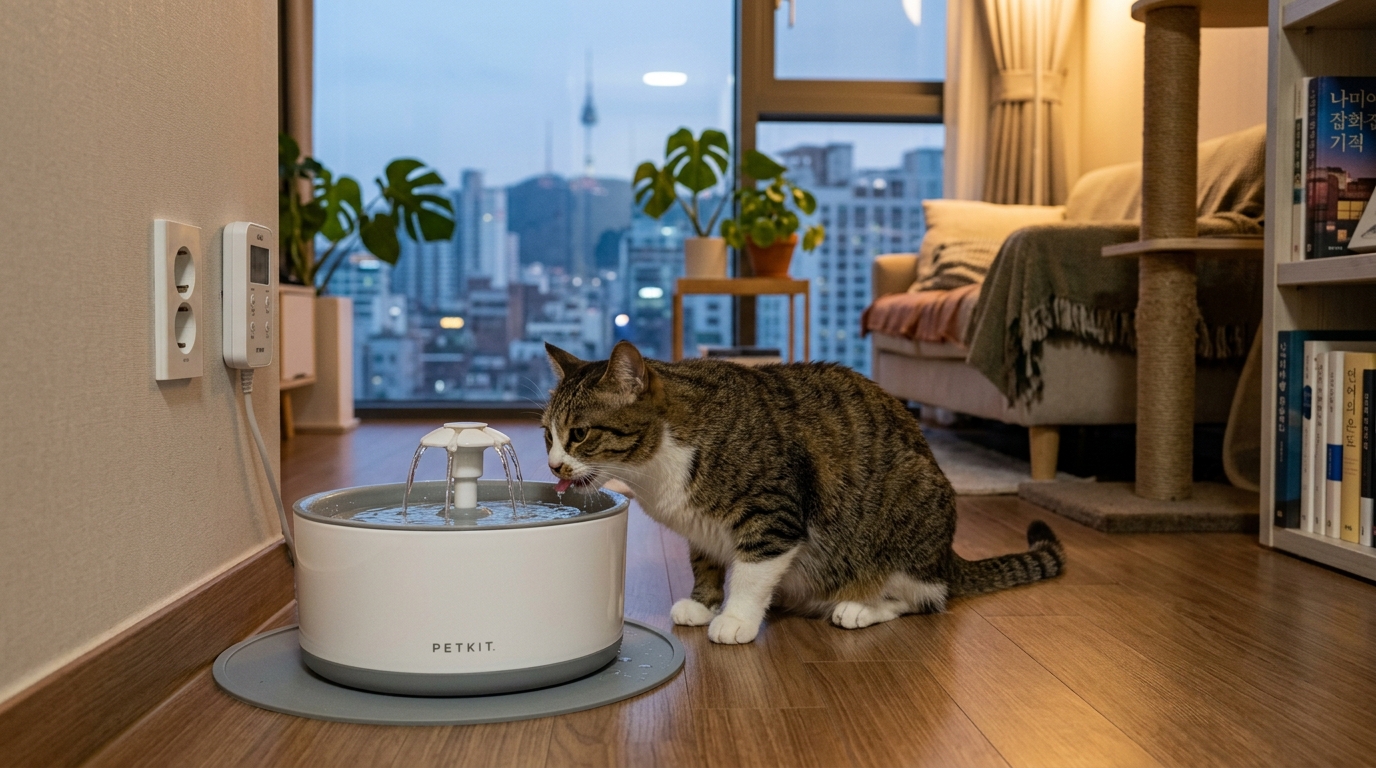
Refreshing feel of flowing water and stimulating visual curiosity: Cats retain a wild survival instinct that perceives spontaneously flowing water as cleaner and safer than stagnant water. It is highly effective to operate a fountain-style pet water purifier or to let water drip slightly from sinks or bathtubs to constantly stimulate your cat’s visual curiosity and desire to drink.

5. Chief Researcher Ansim-i’s Urinary Protection Prescription
A cat’s chronic urine concentration and dehydration are not simple habits; they are signals of life-threatening urinary diseases. Please immediately synchronize the three core water environment improvement rules (MEMO) shared today into your home’s layout.
Ansim-i deeply sympathizes with the worried hearts of pet parents who anxiously look at a full water bowl every day. Getting your cat to become familiar with water is a long journey of profound love that is not completed in a short time. Try implementing these small environmental changes slowly, one by one. Ansim-i wholeheartedly supports a healthy tomorrow for both of you
Recommended Research Data 🕸️

Genetic Heart Diseases Causing Purple Tongue (Cyanosis) in Dogs and the Golden Time for First Aid

Causes of Feline Acne and Sebaceous Cysts: Bacterial Issues in Food Bowls and the Pathological Reasons Why You Should Never Pop Them

Causes of Foul-Smelling Brown Dog Ear Wax: Malassezia Yeast Overgrowth and Ear Cleaner Application Guide
Comments (0)
No comments yet. Be the first to leave one!