
Interpreting Dog Moods by Posture: A Veterinary and Behavioral Mechanism Analysis of 12 Body Languages
Magentalab Research Team
July 14, 2026
Hello! I am Dachshund Ansim-i, Chief Researcher at the Magentalab Pet Research Institute! Today, I’ve brought another informative research report to help ensure a happy life together for you and your furry friends.
A dog’s body language is the physiological output where the emotional state triggered by the Limbic System and the response of the Autonomic Nervous System manifest as external postures. Actions such as a dog tilting its head, shaking its body, or lifting a specific paw go beyond simple expressions of mood; they are complex physiological reflexes aimed at neurohormonal regulation and securing musculoskeletal stability. In this research report, we will precisely analyze the hidden veterinary and medical mechanisms behind 12 typical dog postures to help pet parents objectively evaluate their dog’s condition.
Summary of 12 Dog Postures, Neurological Mechanisms, and Emotional States
| Analyzed Body Posture | Neurological & Physiological Mechanism | Actual Emotion & Behavioral State |
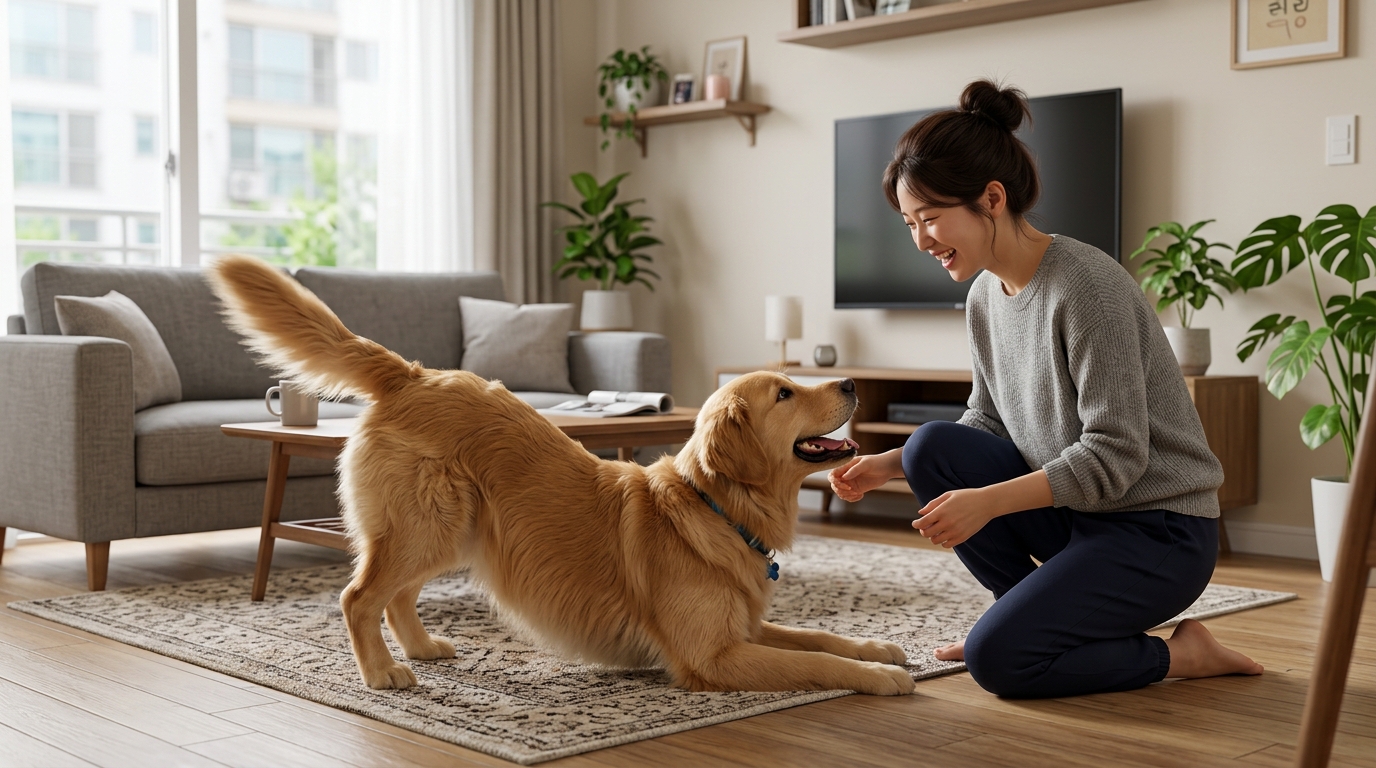
| 1. Play Bow | Induces pleasant sympathetic nervous system excitation by lowering the upper body and raising the hips. | “I am not a threat, and I am fully ready to play.” |
| 2. Head Tilt | Micro-adjustment of the external ear canal for horizontal/vertical frequency analysis of the sound source. | “I am focusing on the sound and cognitively inferring your intentions.” |
| 3. Head Lowering | Submission signal via relaxation of erector spinae muscles, or cervical pain/neurological abnormality. | “I want to avoid conflict, or I am experiencing chronic disc/physical pain.” |
| 4. Stiff Tail | Maximized muscle tension due to a sudden surge of adrenaline from the adrenal medulla. | “I am in a high-alert state with a risk of conflict, showing dominance or tension.” |
| 5. Belly Up | Thermoregulation and perception of extreme safety through the exposure of vulnerable organs. | “I am in a state of 100% trust and relaxation, or submission to appease a threat.” |
| 6. Curled-up | Core body heat preservation and abdominal protection via muscle contraction; NREM to REM sleep stabilization. | “I am resting, protecting my organs and body heat from the environment.” |
| 7. Single Paw Lift | Cognitive uncertainty toward an unknown stimulus and a mild elevation of cortisol. | “I am hesitant and alert regarding an unpredictable stimulus.” |
| 8. Wet Dog Shake | Physical reset for autonomic nervous system homeostasis recovery after sympathetic tension release. | “I am physically shaking off extreme tension or stress to relieve it.” |
| 9. Splooting | Physical extension and pressure distribution of the spinal alignment and muscles around the hip joints. | “I am relieving musculoskeletal stress and entering deep rest mode.” |
| 10. Leaning | Promoting oxytocin secretion and defensive alliance intent through physical closeness. | “I feel secure and am confident that you are my pack.” |
| 11. Pouncing / Stalking | Activation of the target tracking circuit due to a dopamine burst in the nucleus accumbens. | “My predatory instinct is stimulated; I am excited right before lunging.” |
| 12. Out-of-Context Yawning | Calming behavior to reduce stress by lowering brain temperature and regulating respiratory volume. | “I am calming myself down to overcome anxiety or a stressful environment.” |
1. Play Bow: The Positive Sympathetic Excitation Mechanism
The play bow, where a dog presses its upper body to the floor and raises its hindquarters high, is the classic posture initiating play. This posture pleasantly stimulates the sympathetic nervous system, inducing adrenaline secretion and setting the muscles into a preparatory state for sudden physical activity. From a veterinary behavioral perspective, physically lowering their size is a peaceful communication tool to show they have no intention of harming the other party, while declaring that any light biting or wrestling during play is not a “real attack.“

2. Head Tilt: The Hidden Frequency Search Function
A dog tilting its head left and right is not merely an expression of curiosity; it is a highly developed auditory processing mechanism. A dog’s pinna (auricle) structure differs from a human’s, requiring them to calculate minute frequency and time differences when sound arrives from above, below, left, or right. By tilting their head, they make micro-adjustments to the angle of the external ear canal. This signifies a state of high concentration, aiming to clearly filter and cognitively interpret the pet parent’s vocal frequency and intonation.

3. Head Lowering: A Warning of Spinal Pain and a Signal of Submission
A posture where the head is lowered completely below the shoulders with only the eyes rolling upward must be analyzed from two veterinary perspectives. First, from a social relationship perspective, it is a signal of voluntary submission and avoidance, declaring non-threat in response to another’s dominant attitude. Second, from an orthopedic and neurological perspective, if chronic pain from conditions like Cervical Intervertebral Disc Disease (IVDD) or Atlantoaxial Instability (AAI) is present, this is highly likely a pain-avoidance posture where the dog cannot lift its head to alleviate spinal cord compression, requiring precise clinical diagnosis.

4. Stiff, Slowly Wagging Tail: Tension and Fight Hormone Secretion
A posture where the tail is held stiffly high and only the tip vibrates slightly side-to-side is not a sign of joy, but a precursor to strong tension and the expression of aggression. In this posture, norepinephrine secretion from the adrenal medulla spikes, contracting the piloerector muscles and causing the tail hair to stand on end (piloerection). The higher the tail is raised, the wider the pheromones from the anal glands spread into the air, conveying an intent to threaten the opponent by showing off their presence and dominant position.

5. Belly Up: Trust and Gastrointestinal Defense
The behavior of a dog lying on its back and exposing its belly is directly linked to two main brainwave states. Lying with limbs sprawled in a completely relaxed state is a signal that they fully trust the environment as a safe zone with zero predator threats; it is also a physiological homeostasis response to lower body temperature by promoting abdominal heat dissipation. Conversely, lying down with the tail tucked between the legs in front of a threat is a submissive, defensive behavior chosen as voluntary restraint to avoid a fatal attack in a state of extreme fear.

6. Curled-up: Body Heat Preservation and Core Contraction Mechanism
The coiled posture, where the body is rolled into a ball and the head is buried near the tail, is a physiological self-protection action. This posture maximizes thermodynamic efficiency by suppressing heat loss from the exposed abdomen, maintaining core body temperature. Following wild instincts, it is a posture that hides fragile internal organs from predators and induces brainwave stabilization, blocking external sensory stimuli so the brain can safely transition from NREM (non-rapid eye movement) to REM sleep.

7. Single Paw Lift: Stress and Cognitive Delay
Standing still while lifting and bending one front paw off the ground implies a state of cognitive conflict. This is a state of behavioral inhibition that occurs when the fear of an unidentified stimulus intersects with the desire to explore. Because the body’s cortisol concentration is slowly rising and the brain’s frontal lobe has not yet made a decision on how to process the stimulus, pet parents should give the dog enough time to explore rather than forcing a new stimulus upon them in this moment.

8. Wet Dog Shake (Without Water): Stress Hormone Reset Mechanism
The behavior of violently shaking the entire body from head to tail, even when not wet, is classified in veterinary medicine as a “sensory system switch-off” mechanism. When the sympathetic nervous system, stimulated during a state of tension, transitions to a stabilization phase, the animal’s brain sends unconditional contraction and relaxation signals to the entire body’s muscles via spinal motor nerves. This is a physiological stabilization process that forcibly releases built-up muscle tension and resets sensory receptors to restore autonomic nervous system homeostasis.

9. Splooting (Stretching with Hind Legs Back): Musculoskeletal Pressure Distribution
The stretching posture where the front paws are lowered and the hind legs are stretched straight back is a mechanical tension-relief behavior for spinal alignment. This is an orthopedic instinct to physically relieve the static load placed on the erector spinae muscles after crouching for a long time by relaxing the spaces between the vertebrae. It distributes the pressure applied to the lumbar spine and the muscle groups around the hip joints, recovering the joints’ range of motion and facilitating blood circulation, offering a relaxation effect that prevents joint stress.

10. Leaning on the Pet Parent: Proof of Oxytocin Secretion
The leaning behavior, where a dog presses its hips or back against the legs or body of a sitting or standing pet parent and shifts its weight, signifies deep social solidarity. Thermal stimulation through skin contact stimulates the hypothalamus, strongly promoting the secretion of the bonding hormone Oxytocin and reducing cortisol levels. By entrusting their back (a blind spot with no field of vision) to the pet parent, they confirm that they are safe partners and solidify a protective bond within the pack—a sociobiological alliance mechanism.

11. Pouncing/Stalking (Lowering Posture and Staring): Dopamine Surge in Hunting Mode
The posture of straightening the head and spine in a line, keeping the body close to the floor, and approaching quietly without taking their eyes off the target is part of the Predatory Motor Pattern. At this moment, dopamine explosively secretes within the dog’s brain, strongly activating the mesolimbic reward circuit. It induces a state of high immersion in targets like prey or toys, switching the muscle spindle cells into a reflex standby mode for immediate leaping and sprinting.

12. Yawning and Lip Licking (Out of Context): Calming Signal Neural Control
Repeatedly yawning or lightly licking the nose and lips with the tongue in a non-fatigued situation is an emotional calming mechanism. When a dog is exposed to internal threats or environmental stress, their heart rate increases and breathing becomes shallow. By forcibly inducing a yawn, they expand the airway to temporarily increase oxygen intake and lower the brain temperature to reduce the stress response. Simultaneously, licking the lips stimulates saliva secretion to physiologically compensate for dry mouth caused by tension—a self-regulating response.

Recommended Research Data 🕸️

Why Dogs Dislike Having Raspberries Blown on Their Bellies: A Veterinary Scientific Analysis of Skin Sensory Receptor Stimulation
Causes of Dog Separation Anxiety Howling & Door Stalking, and the 5-Step Crate Training Method

Why Cats Obsess Over Scratcher Pads and the Placement Formula to Relieve Territorial Marking Stress
Comments (0)
No comments yet. Be the first to leave one!