

DIY Neonatal Kitten Incubator: The Ultimate Guide to Thermoregulation and Humidity Control
Magentalab Research Team
August 2, 2026
Hello! I am Dachshund Ansimi, the Senior Researcher at Magentalab Pet Research Institute! Today, I’ve brought another informative research report for the happy journey of you and your pets.
What is the very first thing you should do when you rescue a stray neonatal kitten? If you thought about rushing to feed them milk from a bottle, that is a very dangerous misconception. Because the gastrointestinal tract of a rapidly cooling kitten has shut down, feeding them milk before raising their body temperature is a fatal mistake that actually threatens their life. What must be provided even before food is an “incubator” that maintains the perfect temperature and humidity.
Medical Disclaimer: This guide provides the best emergency response pet parents can take. Please consult a veterinarian for an accurate diagnosis and treatment of any health abnormalities, hypothermia, or breathing difficulties in neonatal kittens.
Core Summary Table
| Category | Details | Expected Effects |
| Purpose | Prevent rapid hypothermia and secure the survival rate of rescued neonatal kittens | Prevent organ damage and shock caused by hypothermia |
| Optimal Temperature | Maintain 30~32°C (86~90°F) for Week 1, and 27~29°C (81~84°F) for Weeks 2~3 | Normalize metabolic functions and induce normal digestion/absorption |
| Optimal Humidity | Maintain internal humidity around 50~60% (using wet towels, etc.) | Prevent drying of respiratory mucous membranes and suppress skin moisture loss |
| Essential Supplies | Transparent plastic storage bin with a lid, hot water bottles, blankets, digital thermo-hygrometer | Enables immediate emergency first aid using household items |

1. “Summer Air Conditioning is Also Fatal” The Lack of Thermoregulation in Kittens Under 3 Weeks Old and the Need for an Emergency Incubator Box
Kittens cannot regulate their own body temperature until they are about three weeks old. This is because they have not yet developed the shivering reflex to generate heat by moving their muscles. Even on a hot summer day, a kitten’s body temperature can drop rapidly in an air-conditioned room or during the early morning hours when the temperature difference is significant. If a professional medical incubator is not available, you must immediately create an emergency incubator box using items around you.
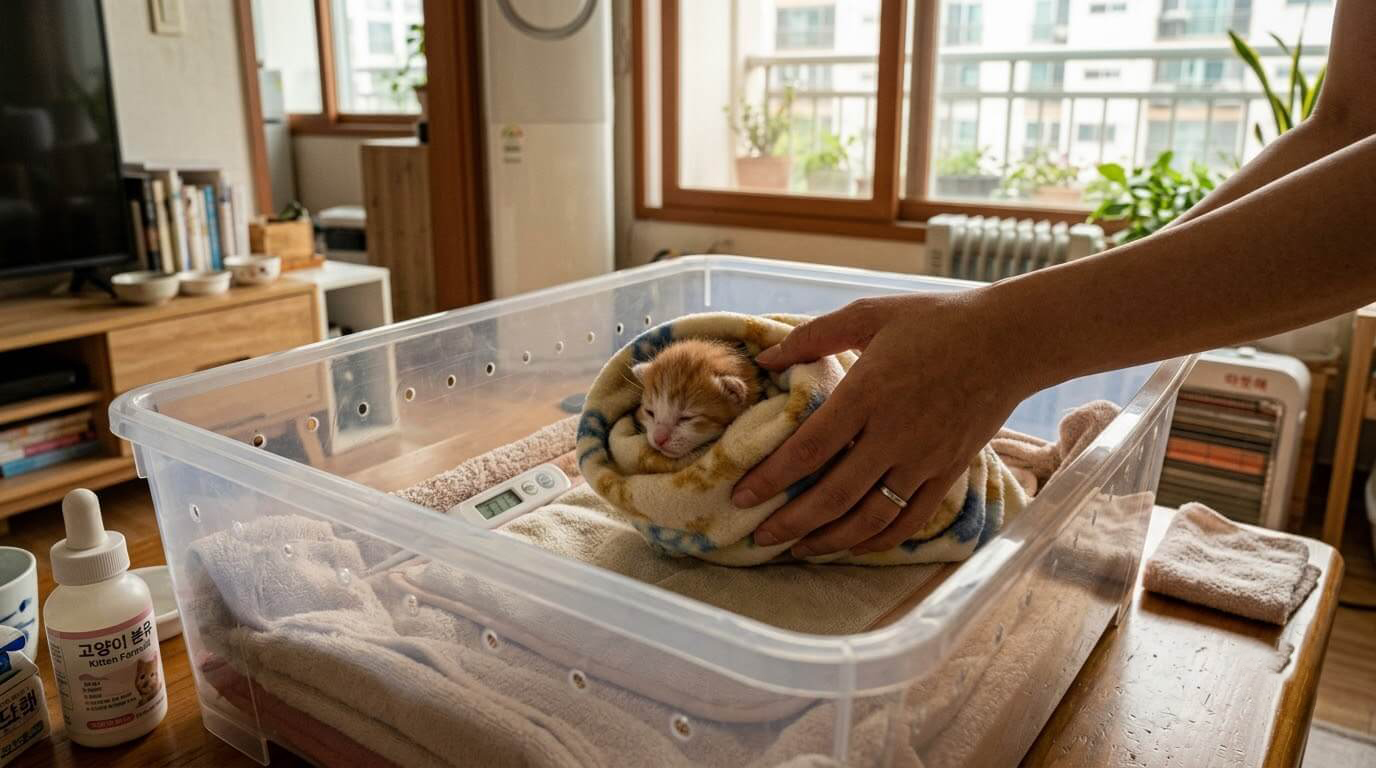
The first thing you need to prepare is a transparent plastic storage bin with a lid. Cardboard boxes are not recommended as they absorb moisture, easily breed bacteria, and have high heat loss. Line the bottom with a soft towel or microfiber blanket, and cover it with a potty pad to manage hygiene. Use microwaveable heating pads or plastic bottles filled with hot water as the primary heat source. It is also essential to attach a small digital thermo-hygrometer inside the box to accurately measure the environment.
“Thickness and Seal are More Important Than Perfect Material” A Realistic Emergency Incubator Using a Sturdy Plastic Storage Bin
To be completely honest, since we are not plastics engineers, we do not know the exact thermodynamic insulation values of the various storage bin materials on the market. However, clinical experience clearly shows that a sturdy plastic box with thick walls and a good seal to block outside drafts serves excellently as an emergency incubator.

2. “A 1-Degree Difference Determines a Kitten’s Fate” Age-Specific Temperature/Humidity Standards and Heat Source Management to Prevent Low-Temperature Burns
The key to operating a successful incubator is precise environmental control tailored to the kitten’s age. For a kitten within its first week of life, maintain a temperature of 30~32°C (86~90°F). Gradually lower it to 27~29°C (81~84°F) in the second week, and 24~27°C (75~81°F) in the third week. Humidity must always be kept at 50~60% so their respiratory tracts do not dry out.
When using hot water bottles or heating pads to maintain the temperature, you must wrap them in multiple layers of thick towels. If a kitten’s thin skin comes into direct contact with the heat source, they can suffer severe low-temperature burns. If the air inside the box becomes too dry, drape a towel soaked in warm water in one corner of the box to create a natural humidifying effect. Because the temperature inside a sealed box can spike in an instant, check the thermo-hygrometer periodically to ensure it does not overheat.

3. “The Most Fatal Mistake of Novice Pet Parents” Creating Hot and Cool Zones to Prevent Heatstroke and Ventilation Designs to Prevent Suffocation
The most fatal mistake novice pet parents make is filling the entire storage bin with heat sources. This causes heatstroke by giving the kitten nowhere to escape. Line half of the box with heating pads to create a “hot zone” (warm area), and leave the other half with just blankets to create a “cool zone.” You must provide enough space so that if their body temperature rises, the kitten can move to a cooler area to regulate their temperature naturally.
Furthermore, people often focus so much on insulation that they forget about oxygen supply. Tightly closing the lid will deplete the oxygen inside and create a risk of suffocation. Use a soldering iron or drill to make several air holes in the plastic lid, or leave the lid half open and cover the top with a thin blanket to ensure both ventilation and insulation are achieved simultaneously.

“Never Feed if the Ears and Paw Pads are Cold” The Principle of “Warm First, Feed Later” for Hypothermic Kittens to Prevent Sepsis
If the tips of the rescued kitten’s ears or paw pads are cold and they are unresponsive, they are already in a state of severe hypothermia. You must never force-feed them milk in this condition. Feeding when their body temperature has dropped below 35°C (95°F) can lead to intestinal blockage (ileus), and the milk will spoil in the stomach, potentially causing death from sepsis.
Place hypothermic kittens in the incubator first and wait until their body temperature gradually returns to normal (37.5~38.5°C or 99.5~101.3°F). Use a thermometer inserted shallowly into the rectum to check their temperature. Only after their body is warm should you warm neonatal kitten milk replacer to match their body temperature and feed it. Keep in mind that rushing out of pity because they might be hungry can actually put the baby in much greater danger.

4. “Bacterial Penetration Through the Umbilical Cord is Fatal” Strict Incubator Hygiene and Safe Umbilical Cord Care That Directly Impacts Life
For neonatal kittens with absolutely no immune system, the hygiene inside the incubator is a matter of life and death. If urine or feces from stimulated bowel movements soil the floor, replace the potty pad without delay. The inside of the box must be cleaned once a day with a pet-safe disinfectant or hot water, and completely dried before use.
Especially for babies whose umbilical cord has not yet fallen off, bacteria on the floor can travel up the cord and cause omphalitis (umbilical cord infection) or a systemic infection. Always keep the floor dry and clean, and do not forcibly remove the umbilical cord until it dries and falls off naturally.

Recommended Research Data 🕸️
The Trap of Pet Rearing Costs: Top 5 Expenditures Pet Parents Regret Most and a Smart Spending Guide

Is My 7-Year-Old Dog a Senior? A Guide to Calculating Dog and Cat Ages and Life-Stage Health Care

Dogs vs. Cats: Mirror Reactions, Senses, and Cognitive Abilities Explained
Comments (0)
No comments yet. Be the first to leave one!