
IVDD in Dachshunds & Corgis: Hind Leg Paralysis Symptoms by Grade and Conservative Treatment Options
Magentalab Research Team
July 18, 2026
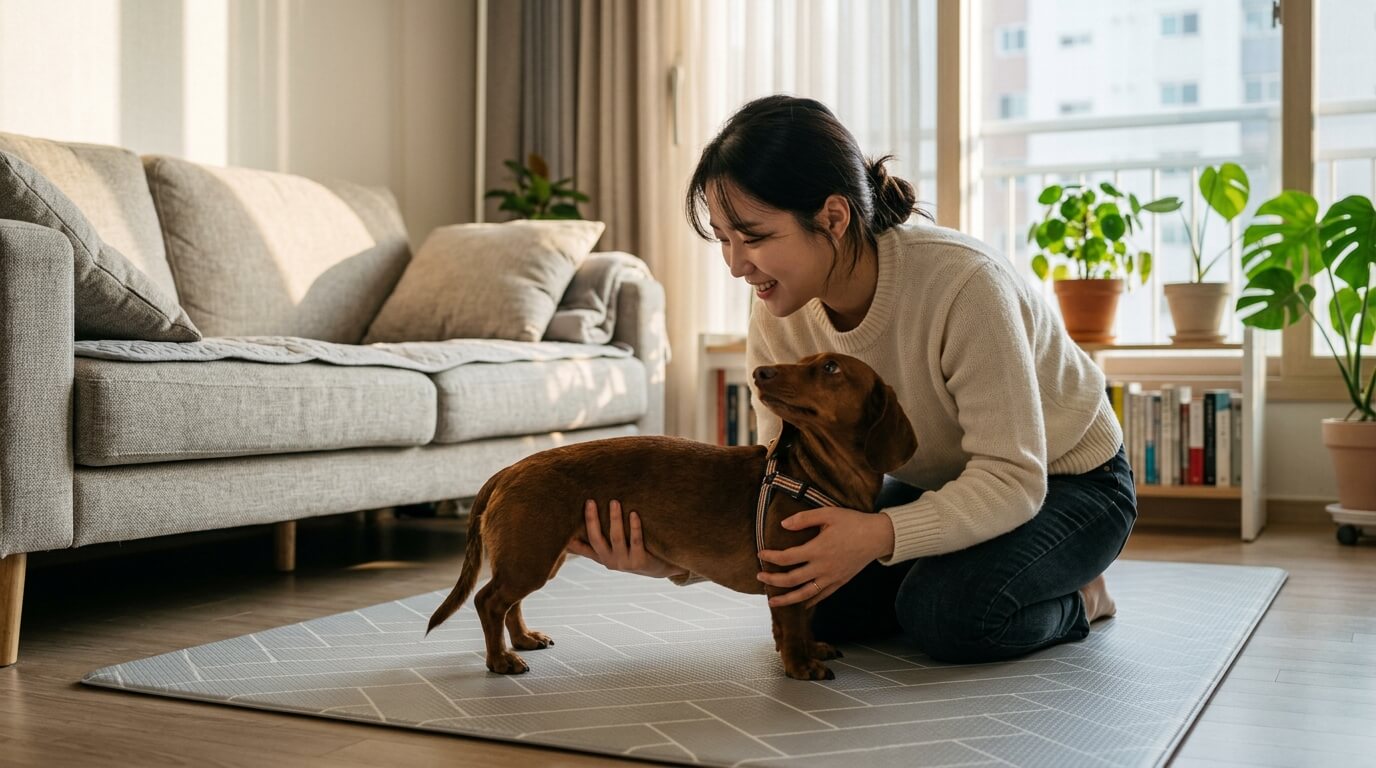
Hello! I’m Ansimi the Dachshund, Senior Researcher at the Magentalab Pet Research Institute! Today, I’ve brought an insightful research report to help pet parents and their beloved dogs enjoy a long, happy life together.
Dachshunds and Welsh Corgis, with their short legs, long backs, and uniquely charming appearances, are deeply loved all over the world, including the US, the UK, and Japan. However, behind this adorable physical structure lies a critical risk factor that threatens their spines for a lifetime. This is Intervertebral Disc Disease (IVDD), a condition where the intervertebral discs (the shock absorbers between the vertebrae) prolapse and compress the spinal cord. The sudden paralysis—characterized by yelping from acute back pain or dragging the hind legs—often leaves pet parents feeling as though their world has collapsed.
Because the necessity of emergency surgery and the overall prognosis depend entirely on the severity of spinal compression and sensory loss, it is absolutely crucial for pet parents to accurately recognize the clinical grades. In today’s report, we will thoroughly examine the anatomical causes of IVDD in chondrodysplastic breeds, how to precisely identify clinical symptoms from Grades 1 to 5, and the scientific methods for conservative treatment to relieve spinal compression without surgery.
| Clinical Grade | Primary Pathology & Spinal Cord Compression | Key Clinical Symptoms & Warning Signs | Proprioception & Deep Pain Response | Recommended Treatment & Golden Hour |
| Grade 1 | Simple disc degeneration and mild nerve irritation; no physical compression of the spinal cord. | Yelping when picked up, arched back (Kyphosis), trembling, reluctance to walk. | Normal (Proprioception intact, hyper-sensitive to pain). | Medical therapy (NSAIDs) and 4–6 weeks of strict cage rest. |
| Grade 2 | Mild spinal cord compression begins; sensory and mild motor nerve inhibition in hind legs. | Ataxia (wobbly gait), dragging the top of the paws on the floor (Knuckling). | Delayed/decreased proprioception (Knuckling observed). | Medical prescription, acupuncture, and strict conservative cage confinement. |
| Grade 3 | Moderate spinal cord compression; voluntary motor signal transmission blocked. | Non-ambulatory (unable to stand voluntarily), dragging hind legs. | Proprioception lost, unable to wag tail, superficial pain perception maintained. | Conservative treatment depending on condition, or surgical decision after diagnostics within 48 hours. |
| Grade 4 | Severe spinal cord compression; loss of bladder/bowel control signals and autonomic nerve paralysis. | Urinary retention (bladder distension), overflow incontinence, hind limb motor function completely paralyzed. | Superficial pain lost, but Deep Pain Perception (DPP) maintained. | Emergency decompression surgery recommended within 24–48 hours; recovery rates drop significantly with only conservative treatment. |
| Grade 5 | Complete spinal cord compression and ischemic necrosis; neural transmission completely blocked. | Complete hind limb paralysis, unresponsiveness, high risk of Myelomalacia. | Deep Pain Perception (DPP) completely absent. | Ultra-emergency MRI and spinal decompression surgery mandatory within 24 hours (Golden Hour). |

1. Genetic Causes of IVDD in Dachshunds and Welsh Corgis: An Analysis of Chondrodystrophy
The Chondrodystrophy Gene and Premature Calcification
Dachshunds and Welsh Corgis are genetically predisposed to Chondrodystrophy, a trait that creates their short legs and long backs. This genetic disease, caused by the FGF4 retrogene mutation, does not merely affect external appearance. It serves as a pathological catalyst that causes the intervertebral discs to undergo premature calcification within the first few months of life.
In a normal dog, the inner Nucleus Pulposus of the intervertebral disc is full of moisture and a jelly-like substance to absorb shock. However, in chondrodysplastic breeds, the nucleus dehydrates and calcifies between 6 to 18 months of age, losing its elasticity and undergoing Chondroid Metaplasia.
The Rapid Pathogenesis of Hansen Type I Prolapsed Intervertebral Disc
IVDD in chondrodysplastic breeds is predominantly Hansen Type I. The hardened, calcified nucleus continuously creates micro-fissures in the surrounding Annulus Fibrosus. Eventually, routine pressure from activities like running or jumping causes the annulus to rupture. At this exact moment, the calcified nucleus material rapidly erupts into the Spinal Canal. Because the Spinal Cord is enclosed in a rigid, bony space, the extruded disc material aggressively compresses the nerves, instantly triggering acute spinal inflammation and paralysis.

2. Recognizing Hind Limb Paralysis Symptoms by Grade and Testing for Deep Pain Perception
Indicators of Ataxia and Motor Paralysis (Grades 1 to 3)
-
Grade 1 (Pain Stage): There is no physical compression of the spinal cord, but micro-tears in the annulus and nerve root irritation cause severe back pain. Your dog may yelp when you try to pick them up, or they may drop their head, arch their back (Kyphosis), and tremble.
-
Grade 2 (Ataxia Stage): The lateral spinal nerves responsible for motor function begin to be compressed, leading to decreased Proprioception. The dog’s hind legs will wobble, and you will frequently observe “Knuckling” (dragging the top of the foot on the floor).
-
Grade 3 (Paresis Stage): Spinal compression worsens. The dog becomes non-ambulatory, unable to support their weight on their hind legs. They will rely solely on their front legs to prop up their upper body while dragging their lower half.
Urinary Retention and Clinical Measurement of Deep Pain Perception (Grades 4 and 5)
-
Grade 4 (Complete Paralysis & Autonomic Loss): Voluntary motor skills are 100% lost. Autonomic nerve signals are blocked, meaning the dog cannot control urination or defecation. Urine collects in the bladder (urinary retention), leading to overflow incontinence.
-
Grade 5 (Loss of Deep Pain & Myelomalacia Warning): The deepest pain nerve bundles inside the spinal cord are completely blocked. At this stage, superficial pain (feeling a pinprick on the skin) is entirely gone.
Veterinarians use sturdy hemostatic forceps to firmly pinch the bones of the dog’s hind toes to test for Deep Pain Perception (DPP). Unlike the simple withdrawal reflex (an involuntary flinch), a dog is diagnosed with Grade 5 if there is zero conscious pain response reaching the brain (such as crying out, growling, or turning their head). This is an extreme emergency; without decompression surgery within 24 hours, the likelihood of permanent paralysis is incredibly high.

3. Conservative Treatment Guidelines: 4 Weeks of Strict Cage Rest
The Physiological Healing Principles of Strict Cage Confinement
For dogs with mild neurological symptoms (Grades 1 or 2), or Grade 3 dogs who cannot undergo surgery due to physical constraints, Conservative Treatment is applied. The core of this treatment is strict Cage Confinement.
For the ruptured annulus to naturally heal and absorb the extruded material, spinal movement must be absolutely minimized. Routine walking, shaking, or even wagging the tail can push more disc fragments out, re-compressing the spinal cord. The dog must be confined to a crate or small playpen—just barely larger than their body length—to keep their head and entire spine stabilized for a minimum of 4 to 6 weeks.
NSAIDs Prescription and Absolute Rest Rules
To reduce acute swelling of the nerve roots and manage pain, veterinarians will prescribe breed-safe Non-Steroidal Anti-Inflammatory Drugs (NSAIDs) like Carprofen, Meloxicam, or Firocoxib, or a short-term steroid therapy.
There is one golden rule pet parents must strictly follow here: Just because the medication temporarily relieves the pain and brings back your dog’s energy, you must absolutely not let them out of the crate or allow them to walk. It takes at least 4 weeks for the spinal ligaments and annulus to form micro-fibrous bonds. The moment a pet parent lets their guard down, a secondary massive herniation can occur, frequently resulting in an emergency room visit for acute complete paralysis. Please keep them strictly confined to the cage 24/7, except during feeding or potty breaks.

4. Surgery Costs and Strategies to Prevent Myelomalacia
Hemilaminectomy Guidelines and Estimated Costs
Grade 3 dogs who do not respond to conservative treatment, and Grade 4–5 dogs within 48 hours of losing deep sensation, require surgical decompression without delay. The gold standard surgical method is a Hemilaminectomy. A veterinary surgeon uses a micro-drill to shave off one side of the compressed vertebra (lamina) to create a window. They then use precision tools to carefully scrape out the extruded nucleus material pressing against the spinal cord, physically removing the pressure.
-
Estimated Costs: You can generally expect to allocate between $4,500 and $7,500 in total. This includes pre-operative MRI imaging ($800–$1,200), the Hemilaminectomy procedure ($2,500–$4,500), and post-operative hospitalization and intensive care ($1,000–$2,000).
Monitoring and Preventing Ascending/Descending Myelomalacia
The most terrifying complication for a Grade 5 IVDD patient is progressive Myelomalacia. This is a condition where the spinal cord tissue essentially liquefies and dies due to extensive bleeding and restricted blood flow caused by severe compression.
This necrosis spreads toward the head (Ascending) and the tail (Descending) from the injury site. It is a fatal, incurable disease that eventually reaches the cervical nerves controlling the respiratory muscles between the ribs, causing spontaneous respiratory failure. Even after surgery, the dog must be closely monitored for 3 to 5 days. Veterinarians will continuously check hind limb reflexes, changes in front limb pain sensitivity, abdominal expansion during breathing, and body temperature to detect any signs of myelomalacia.

5. Daily Relapse Prevention: Installing Mats and Ramp Training
The adjacent spinal segments to a herniated disc have a very high relapse rate due to compensatory stress. Therefore, their daily living environment must be completely transformed to be spine-friendly so they can enjoy the happiness of walking on all four legs for life.
The Biomechanical Importance of Wall-to-Wall Non-Slip Mats
When Dachshunds and Corgis slip while walking or running on hard living room floors, immense torsional stress is concentrated on their long spinal axis to regain balance. This is a primary culprit for micro-tearing the annulus fibrosus.
Please install high-elasticity, eco-friendly PVC non-slip mats (at least 5mm thick) seamlessly across all areas where your dog plays. This ensures their nails and pads grip the floor perfectly, completely blocking the lateral physical pressure distributed to the lower back while walking.
Adapting to Incline Ramps for Beds and Sofas Jumping vertically on or off a sofa or bed slams shock energy equal to at least 3 to 5 times their body weight directly into the lumbar spine. You must install incline ramps (slopes) with an angle of 30 degrees or less under all tall furniture. Stepped stairs force long-backed breeds to repeatedly bend their spines up and down, which is actually harmful. After installing the ramps, use positive reinforcement (such as clicker training and treat rewards) to establish a consistent rule: they must only use the ramp to get up and down, never jumping directly to the floor.

6. Senior Researcher Ansimi’s Prescription for Spinal Nerve Protection
When your dog suddenly collapses in the morning, their hind legs giving out, I can feel with all my heart the dark terror and pain reflected in your eyes as you look at them in panic. Please do not blame yourself or shed tears thinking, “Did I walk them too much?” or “Did they twist something while we were playing yesterday?” This is absolutely not your fault. It is simply a destined physical vulnerability that these small, lovable breeds carry as a result of their long history of companionship with humans.
However, it is far too early to despair. If you strictly adhere to the clinical grade recognition guidelines, the DPP pain response checks, and the rigorous 4-week crate rest protocol I have deeply shared with you today, your dog will once again wag their tail vigorously and run across a soft living room mat. The trembling, loving touch of a pet parent wrapping around their weakened back is a far more powerful healing vaccine than any advanced surgical tool. Stay strong. I, Ansimi, will walk by your side until the very end with cool logic and warm compassion.
Recommended Research Data 🕸️
Hidden Symptoms of Patellar Luxation in Pomeranians & Maltese by Stage, and the Standard for Choosing Dog Beds, Stairs, and Mats

Genetic Testing for Feline Hypertrophic Cardiomyopathy (HCM) in Maine Coons & Ragdolls: Timing and Emergency Response to Acute Hind Leg Paralysis (ATE) / Saddle Thrombus

Causes of Feline Acne and Sebaceous Cysts: Bacterial Issues in Food Bowls and the Pathological Reasons Why You Should Never Pop Them
Comments (0)
No comments yet. Be the first to leave one!