
Why Is My Cat’s Tail Quivering? Greeting, Urine Spraying, and When Shaking May Be a Warning Sign
Magentalab Research Team
August 23, 2026
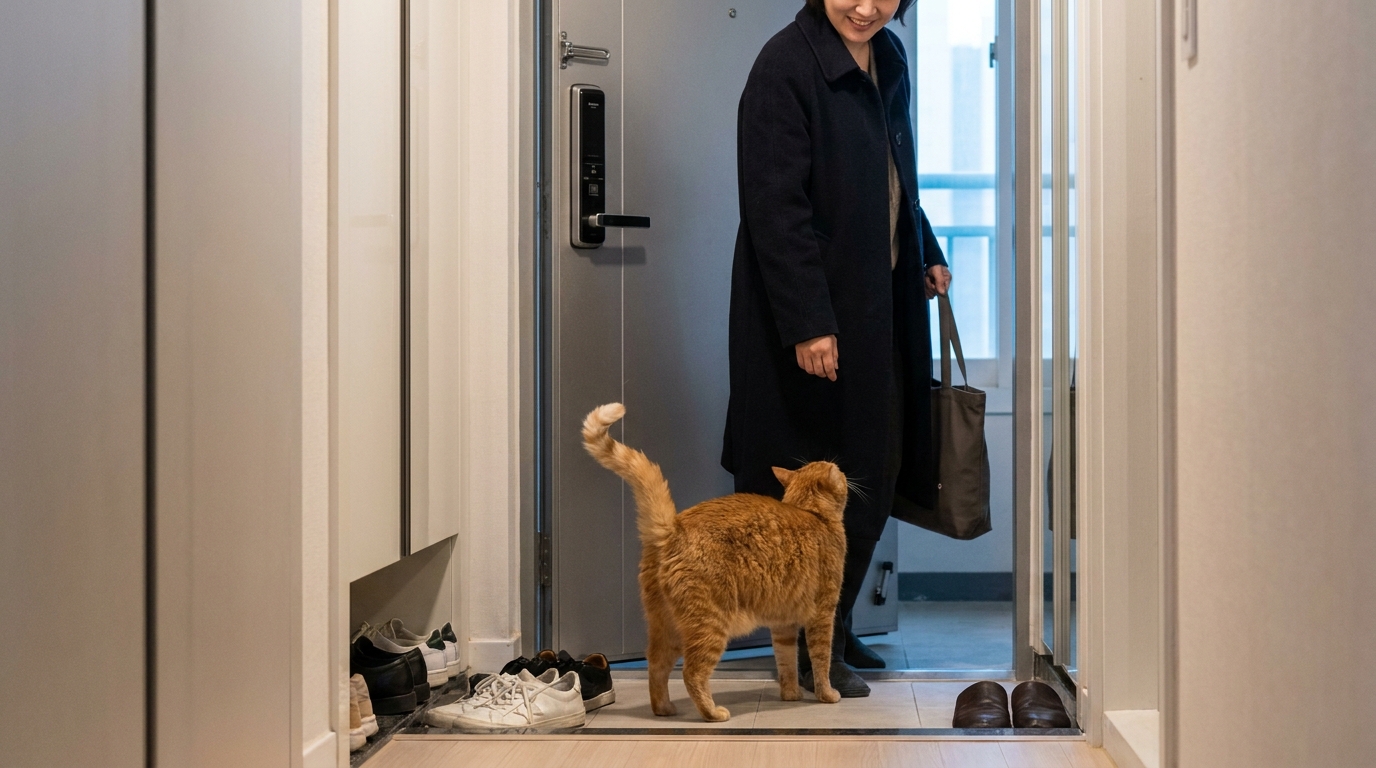
You open the front door and your cat comes trotting toward you.
The tail is straight up in the air, and suddenly it begins to vibrate or quiver very quickly. Sometimes the back feet seem to shift a little too.
If you have never seen it before, the first thought can be unsettling.
“Is my cat having some kind of tremor?”
Then you look more closely. Your cat is rubbing against your legs, walking normally, and seems perfectly comfortable. So you search online and find a completely different answer:
“It means your cat loves you.”
That explanation is not entirely wrong, but it is too absolute.
An upright quivering tail can appear during friendly greeting, excitement, or anticipation. But a quivering tail does not automatically mean love.
A nearly identical tail movement can also happen when a cat urine-marks a wall.
And if the shaking is not limited to the tail — if the cat is trembling all over, walking strangely, losing balance, or acting less aware than usual — this may no longer be a body-language question at all.
That is why Ansim looks at the scene around the tail, not just the tail itself.
Who was your cat approaching? Was the rear pointed toward a wall? Did any urine come out? Was the rest of the body moving normally?
Those details change the meaning.
| What you see | Possible interpretation | What to check next |
|---|---|---|
| Cat approaches you with tail upright and briefly quivering | Greeting, excitement, anticipation | Relaxed body, rubbing, normal walking |
| Tail quivers before food or play | High anticipation or excitement | Focus on food, toy, or familiar routine |
| Cat backs toward a wall with tail upright and trembling | Possible urine spraying | Small amount of urine on a vertical surface |
| Tail is upright but fur is dramatically puffed | Fear, surprise, high arousal | Ears, back fur, posture, nearby trigger |
| Only the tail tip twitches while watching prey or a toy | Focus or predatory excitement | Bird, toy, or moving object nearby |
| Tail and whole body tremble | Not explained by tail language alone | Balance, gait, weakness, pain, awareness |
| Trembling with falling, abnormal walking, or altered consciousness | Medical evaluation needed | Duration, recurrence, seizure-like activity |
Why Does My Cat’s Tail Quiver When They See Me?
If your cat comes toward you voluntarily, the answer may be social excitement.
Cats often use an upright tail during friendly social interactions. Some cats add a rapid quivering or vibrating movement when they are highly aroused in a positive context.
Cats Protection describes a non-spraying tail quiver as a behavior that may occur in greeting situations, including when a cat becomes excited by seeing a familiar person.
VCA also notes that tail quivering can be associated with excitement when a cat sees a person.
So if your cat runs to you after you come home, tail upright and vibrating, then rubs against your legs and continues moving normally, it is reasonable to read the moment as positive.
What Ansim would avoid is turning that into:
“Tail quiver = 100% love.”
Cats do not communicate with one fixed dictionary.
Your cat may be pleased to see you. They may also be excited because you usually feed them, play with them, or open a favorite door when you come home.
A better interpretation is:
“Something about this moment has my cat highly socially aroused and engaged.”
If that excitement is paired with relaxed approach, rubbing, and voluntary contact, the social meaning is likely friendly.
Why Does My Cat’s Tail Shake Before Food?
This is another very common scene.
A cat who looks half asleep suddenly hears the food pouch open and rushes into the kitchen with the tail upright and trembling.
Is that love too?
Not necessarily.
It is probably better understood as anticipation and excitement.
Cats learn routines very quickly. The sound of a can opening, a treat drawer moving, or a favorite wand toy being picked up predicts what comes next.
That expectation can create a brief burst of arousal.
If your cat is otherwise walking normally, focused on the expected food or play, and settles afterward, the tail movement alone is not concerning.
The situation becomes more important if the shaking continues without an obvious trigger or appears together with other abnormal movements.
A Quivering Tail and a Twitching Tail Tip Are Not the Same Thing
People often describe several completely different movements as “my cat’s tail is shaking.”
Imagine your cat sitting at the window watching a bird.
The body becomes still, the eyes lock onto the target, and only the very end of the tail begins to flick or twitch.
You may see the same thing during play when your cat is preparing to pounce.
That is not the same movement as a cat walking toward you with the entire tail upright and vibrating rapidly.
A broad side-to-side tail swish is different again.
People who are used to dogs sometimes assume that more tail movement means more happiness.
With cats, that can be misleading.
If you are petting your cat and the tail begins lashing harder from side to side while the body becomes tense, your cat may be telling you that the interaction is becoming too much.
The question is not simply whether the tail is moving.
Look at how it moves, where it is positioned, and what the cat is doing at the same time.

The Most Confusing Look-Alike: Urine Spraying
This is the behavior every cat parent should know how to distinguish.
Your cat walks toward a wall, door, cabinet, curtain, or another vertical surface.
Instead of facing the surface directly, the cat positions the rear toward it.
The tail goes upright.
It starts to quiver.
The back feet may make small stepping movements.
Then a small amount of urine is released onto the vertical surface.
That is much more consistent with urine spraying, also called urine marking, than with a greeting.
VCA and Merck Veterinary Manual describe spraying as different from ordinary urination.
During normal urination, a cat typically squats and empties a larger amount of urine onto a horizontal substrate, such as litter.
During spraying, a cat usually remains standing and directs a smaller amount of urine backward toward a vertical surface while the tail may be held upright and quiver.
Here is why this confuses so many people:
the tail itself can look surprisingly similar to a greeting quiver.
So do not decide based on the tail alone.
Look at where the cat’s rear is pointing.
Then check whether urine was actually released.
Do Only Male Cats Spray?
No.
Urine marking is often associated with intact male cats, and sex hormones can influence the behavior.
But females can spray too.
Neutered and spayed cats can also continue or begin urine marking.
So these assumptions are unsafe:
“My cat is female, so it cannot be spraying.”
“My cat is neutered, so marking is impossible.”
Indoor spraying may be associated with social or environmental stress.
A neighborhood cat appearing outside the window, a new cat entering the home, moving to a new house, major furniture changes, or tension between cats sharing resources can all be relevant in some cases.
That does not mean you need to diagnose the cause yourself.
It means punishment is not the answer.
Why Punishing a Cat for Spraying Usually Makes Things Worse
Finding urine on a wall is frustrating.
The smell is strong, and cleaning it is unpleasant.
But cats do not spray because they are trying to get revenge on you.
Urine marking is a communication behavior.
When it appears indoors, stress, social tension, or environmental triggers may be part of the picture.
Yelling, spraying the cat with water, or dragging the cat back to the soiled area does not solve the reason the marking happened.
It may make the home feel even less predictable or safe.
Clean the area appropriately, but do not turn the event into punishment.
If spraying is new or persistent, first make sure there is no medical problem contributing to urinary changes, then consider environmental and behavioral factors.
What If My Cat Pees on the Bed Instead of Spraying a Wall?
That is not automatically spraying.
Urine marking and inappropriate urination can look different.
Spraying more often involves a standing posture and a relatively small amount of urine directed onto a vertical surface.
A cat who squats on a bed, rug, floor, or other horizontal surface and empties a larger amount of urine may be showing ordinary urination outside the litter box rather than classic spraying.
That distinction matters.
Urination outside the box can occur for behavioral reasons, but it can also be associated with medical problems.
So if a cat suddenly begins urinating outside the litter box, do not jump straight to:
“My cat is angry.”
Pay particular attention if the cat is entering the box repeatedly, straining, vocalizing, licking the genital area, or producing only tiny amounts of urine.
Those signs need medical attention.
My Cat’s Tail Quivers but No Urine Comes Out. Is That a Greeting?
Possibly.
If the behavior happens when your cat approaches you, there is no urine, the body stays relaxed, the cat rubs against you, and the behavior ends quickly, a social greeting or excitement interpretation is more likely.
Some cats make small stepping movements with the back feet while doing this, which can make the behavior look even more like spraying.
That is why one isolated movement can be misleading.
Look for the pattern.
Does your cat do it mainly when you come home?
Before food?
During friendly social interaction?
Or does the cat repeatedly back up to doors and walls in a marking posture?
Patterns are more useful than snapshots.

Will Neutering or Spaying Stop Spraying?
It may help, especially when sex hormones are contributing to the marking behavior.
But it is not a guaranteed off-switch.
Neutered and spayed cats can still spray.
If social tension, environmental changes, outside cats, or resource competition are contributing, those factors may still need to be addressed.
If spraying suddenly begins, consider what has changed.
Did another cat move into the home?
Is a neighborhood cat appearing outside a window?
Did you move?
Was there construction?
Did you rearrange the home?
Are cats blocking each other from litter boxes, food, resting spots, or hallways?
You do not need to solve every behavioral factor on your own.
If urine marking is persistent or mixed with other urinary changes, veterinary evaluation should come before assuming it is purely behavioral.
Read the Whole Cat, Not Just the Tail
The tail is easy to notice.
That is why people tend to focus on it.
But feline emotion is not written on the tail alone.
Look at the ears.
Are they relaxed and forward, or flattened sideways or backward?
Look at the eyes.
Look at the tension in the body.
Is the fur lying flat, or is the tail dramatically puffed?
Is the cat voluntarily approaching you, or looking for an escape route?
An upright tail by itself does not guarantee a happy cat.
A cat with an upright, dramatically puffed tail, tense body, and arched posture may be frightened or highly aroused.
That is a very different scene from a relaxed cat approaching you with an upright quivering tail.
Think of cat body language like a sentence.
The tail is one word.
The ears, eyes, body posture, movement, and context finish the sentence.
Should I Pet My Cat When the Tail Quivers?
If your cat is voluntarily approaching and rubbing against you, gentle interaction is usually reasonable.
But a quivering tail is not permission to scoop the cat up.
A cat may be happy to greet you and still dislike being held.
Start with the kind of touch your cat usually enjoys, such as a brief stroke around the cheeks or chin.
Then watch what happens.
Does your cat lean in?
Stay close?
Move away?
High excitement can also make some cats less tolerant of prolonged petting.
Receiving a friendly greeting does not mean you need to turn it into a long cuddle session.
Let the cat decide how much contact continues.
What If My Cat’s Tail Is Quivering and Puffed Up?
That deserves a different interpretation.
The tail may still be upright, but if the fur is dramatically puffed, the cat may be startled, frightened, or in a state of high arousal.
You may also see a tense body, raised back hair, sideways posture, or ears turned backward.
Do not treat that as the same thing as a relaxed greeting.
Look for what startled the cat.
Give space.
Trying to pick the cat up and “comfort” them physically may make the situation more stressful.
When Tail Quivering Stops Being a Body-Language Question
A cat who briefly quivers the tail when greeting you is very different from a cat whose body is shaking involuntarily.
Neurologic problems can affect gait, balance, coordination, posture, strength, behavior, and level of awareness.
Merck Veterinary Manual includes these features as important parts of neurologic assessment.
So if you notice the tail moving and also see changes such as generalized trembling, stumbling, falling, weakness, or altered responsiveness, do not keep trying to decode the emotion behind the tail.
At that point, the more important question is:
“Is my cat medically okay?”

Warning Signs That Need More Than Behavioral Interpretation
A checklist is useful here because these signs are easier to act on when they are easy to scan.
Seek veterinary advice if tail shaking is accompanied by:
- trembling involving the head or whole body,
- stumbling, falling, or obvious loss of balance,
- sudden weakness in one or more legs,
- markedly abnormal walking,
- unusual staring or reduced responsiveness,
- collapse or loss of consciousness,
- seizure-like stiffening or repeated limb movements,
- persistent pain when the tail or lower back is touched,
- new inability to move the tail normally,
- urinary or bowel changes after an injury involving the tail or pelvis.
These are not situations where “cat tail meaning” should be the main concern.
The combination of signs matters more than the tail movement itself.
How Is a Seizure Different From a Tail Quiver?
A classic generalized seizure usually looks very different from a social tail movement.
A cat may lose consciousness, fall over, become rigid, or make repeated involuntary movements with the limbs.
Drooling, urination, or defecation can sometimes occur.
Afterward, the cat may seem disoriented or behave differently for a period of time.
But not every seizure looks dramatic.
VCA notes that focal seizures may involve more limited muscle movements or changes in behavior or awareness.
That is why you do not need to prove at home that something “definitely is not a seizure.”
If a new, unexplained movement keeps happening, a short video can be very useful for your veterinarian.
Film only if it is safe.
Do not hold the cat down or deliberately trigger the episode to get better footage.
Does a Tail Tremor Alone Mean My Cat Needs a Vet?
Not necessarily.
A cat who only quivers the upright tail for a few seconds when greeting you, then immediately returns to normal behavior, eats normally, walks normally, and uses the litter box normally may simply be showing a behavioral signal.
The situation changes if the movement is new, happens repeatedly without a clear context, or appears together with pain or functional changes.
If your cat suddenly cannot move the tail normally, reacts painfully when the tail is touched, or developed the change after being caught in a door, falling, or another injury, veterinary assessment is appropriate.
The tail contains bones, muscles, and nerves.
Injury can affect more than appearance.
Urination and defecation changes after tail or pelvic trauma are especially important to report.
What Should I Look for If My Cat Suddenly Starts Spraying?
Imagine a cat who has used the litter box reliably for years and suddenly begins leaving urine on the entryway wall.
The first instinct may be to focus on cleaning.
Cleaning matters, but it does not answer why the behavior started.
First, decide whether the posture really looks like spraying.
Was your cat standing?
Was the rear directed toward a vertical surface?
Was the tail upright and quivering?
Was only a small amount of urine released?
Then think about recent changes in the environment.
But do not spend days investigating behavioral triggers while ignoring urinary health.
New marking or urination outside the litter box deserves medical consideration too, especially when the cat’s frequency, volume, posture, or comfort during urination has changed.
Why You Should Not Assume “Spraying” Means “Behavior Problem”
Cats with urinary discomfort may change where or how they urinate.
That can be mistaken for marking.
If a cat is repeatedly trying to urinate and producing very little, especially with discomfort or vocalization, this is not a situation to solve with behavioral training.
For male cats in particular, inability to pass urine can become an emergency.
So when urinary behavior changes suddenly, the safest order is:
medical problem first, behavioral interpretation second.
Once medical causes have been evaluated, environmental or social contributors can be addressed more confidently.
A Simple 5-Step Check When Your Cat’s Tail Starts Quivering
This is one place where a short checklist is genuinely useful.
- Where is your cat? Walking toward you, or backed up against a wall or piece of furniture?
- Is urine coming out? Look for a small amount directed onto a vertical surface.
- What is the rest of the body doing? Normal relaxed walking, or generalized trembling and poor balance?
- How long does it last? A few seconds in a specific exciting situation, or repeated without a clear trigger?
- What else has changed? Appetite, litter-box habits, gait, energy, awareness, or response to touch?
Those five observations tell you far more than the phrase:
“My cat’s tail shook.”

Frequently Asked Questions About a Cat’s Quivering Tail
My cat only does this when they see me. Does that mean they love me?
It can be a positive social response.
If your cat voluntarily approaches, rubs against you, holds the tail upright, and briefly quivers it, greeting or excitement is a reasonable interpretation.
But one tail movement cannot measure love with certainty.
Read the entire interaction.
My cat’s back feet move while the tail quivers. Is that spraying?
Not necessarily.
Small stepping movements can be seen during urine-marking postures, but similar movements may also occur during a non-spraying tail quiver.
Check whether the cat is backed toward a vertical surface and whether urine is actually released.
Can neutered cats still spray?
Yes.
Neutering can reduce some hormonally influenced marking behavior, but it does not guarantee that spraying will never occur.
Neutered males and spayed females can still urine-mark.
Can female cats spray?
Yes.
Urine marking is not limited to males.
My cat’s tail shakes when I prepare food. Is that abnormal?
If the behavior is brief, occurs in an exciting predictable context, and your cat otherwise acts normally, it may simply reflect anticipation or arousal.
If shaking continues afterward or affects the whole body, look more closely.
Is a twitching tail tip the same as a quivering upright tail?
Not necessarily.
Cats may twitch the tip of the tail while focusing on prey, birds, toys, or another interesting stimulus.
That can be different from a rapid vibration of the whole upright tail during greeting or marking.
My cat twitches while sleeping. Is that the same thing?
No.
Small movements during sleep are a different context from an awake cat using the tail during social interaction.
If your awake cat shows repeated generalized shaking, balance problems, or changes in awareness, veterinary evaluation may be needed.
Should I record a video of the shaking?
Yes, if you can do so safely.
A brief video can help your veterinarian evaluate an intermittent movement that may not happen during the appointment.
Do not restrain your cat or deliberately trigger the behavior just to capture it.
Instead of Asking “Does My Cat Love Me?”, Look at the Whole Scene
A cat running toward you with the tail straight up and vibrating is an adorable sight.
And yes, your cat may be genuinely pleased to see you.
You do not need to turn every sweet behavior into a medical concern.
You only need to let go of one overly simple rule:
“A quivering tail always means love.”
The same basic tail movement can appear in very different situations.
A cat may be greeting you.
A cat may be urine-marking a wall.
Or a cat may have involuntary shaking that is part of a medical problem.
The difference becomes much clearer when you ask three questions:
Is my cat coming toward me?
Is my cat backing up to a surface and releasing urine?
Is anything else about the body or awareness abnormal?
If it is a friendly greeting, enjoy it.
If it is spraying, do not punish the cat — look for the reason.
If the whole body, balance, walking, or awareness is abnormal, stop reading body language and start thinking about health.
Understanding cats does not mean turning every behavior into a cute message.
Sometimes the most caring interpretation is simply noticing that two similar-looking movements are not the same.
Ansim’s Research Notes
When someone tells Ansim, “My cat’s tail vibrates every time they see me,” the first image that comes to mind is often a pleasant one.
A cat runs toward the door, tail high, body relaxed, then rubs against the person who just came home.
That can absolutely look like a happy greeting.
But I still want to see the next few seconds.
Does the cat stop in front of a wall?
Does any urine appear?
Is only the tail moving, or is the whole body shaking?
Does the cat walk away normally afterward?
The word “quivering” can describe several very different things.
So the next time your cat’s tail starts vibrating, remember three questions:
Coming toward me? Spraying toward a surface? Or shaking somewhere else too?
Those three details will tell you much more than the tail alone.
🔬 Veterinary Evidence & References
Magentalab Research Team has reviewed relevant veterinary guidelines to verify the core content.
An upright quivering tail can occur in different contexts. Feline body-language resources describe a non-spraying tail quiver as a behavior that may appear during friendly greeting or heightened social excitement, while veterinary behavior references caution that a very similar tail posture can also occur during urine marking. The context around the movement is therefore essential. Urine spraying is typically different from normal urination. A cat often remains standing, positions the rear toward a vertical surface, holds the tail upright and may quiver it, then releases a relatively small amount of urine backward. Spraying may occur in males or females and may persist even after neutering or spaying. By contrast, generalized trembling, ataxia, weakness, abnormal posture, changes in awareness, or seizure-like episodes are not ordinary tail-language signals and may require neurologic or other medical evaluation.
Feline Behaviour Visual Guides: Body Language
How Does A Kitten Communicate With Their Tail?
Cat Behavior Problems: Marking and Spraying Behavior
Behavior Problems of Cats
The Neurologic Evaluation in Cats
Seizures and Epilepsy in Cats
Do not diagnose a behavioral or neurologic problem based on tail movement alone. If shaking begins suddenly and is accompanied by collapse, whole-body tremors, difficulty walking, weakness, altered responsiveness, or seizure-like activity, seek veterinary care rather than trying to interpret the behavior at home. If urine marking or urination outside the litter box begins suddenly, do not punish the cat or assume it is “bad behavior.” Urinary disease and other medical problems should be considered, especially if the cat is straining, urinating frequently, vocalizing, or producing little to no urine.
* Evidence classification based on Magentalab evaluation standards.
Recommended Research Data 🕸️

Why Does Your Cat Run Ahead of You and Suddenly Stop? Is It a Cute “Let’s Go Together!” Signal?

Why Does My Cat Rub Its Face on the Wall? Head Bunting vs. Dangerous Head Pressing
Why Does My Cat Lie on the Bathroom Floor? Normal Reasons and When to Worry
Comments (0)
No comments yet. Be the first to leave one!