

How to Choose a Cat Tower or Cat Pole: Pros, Cons, and Perfect Vertical Space Layouts for Chonky Cats
Magentalab Research Team
August 5, 2026
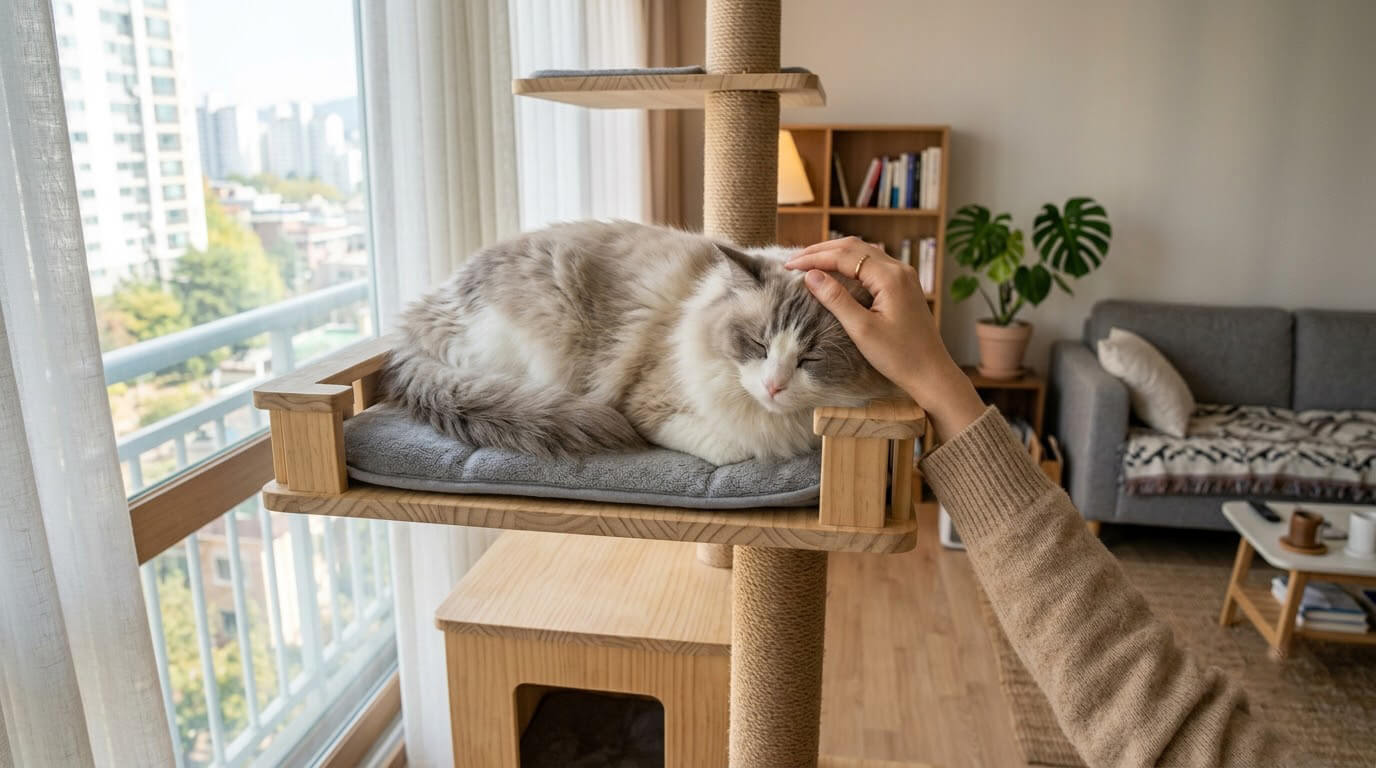
Hello! I’m Ansim-i the Dachshund, Senior Researcher at Magentalab Pet Research Institute! Today, I’ve brought another informative research report to help you and your pets live happily together.
Many pet parents ambitiously place large, fancy cat towers costing hundreds of dollars right in the middle of their living rooms for their cat’s happiness. Surprisingly, however, 80% of the reasons cats ignore and abandon cat towers are not due to “design” or “price,” but a failure in “location” and “pathway design.” Forcing an unstable vertical space into a cramped area induces severe stress in cats, and step heights that don’t accommodate their body types cause serious joint diseases. If you don’t want your expensive cat tower to turn into a giant laundry drying rack, you need to completely flip your common sense regarding vertical spaces right now.
Cat Tower & Cat Pole Selection Criteria by Cat’s Age and Living Environment
| Structure & Type | Pros & Cons | Suitable Cat Age & Body Type | Recommended Placement Guide by Living Environment |
| Basic Cat Tower | Excellent stability with wide steps / Takes up a lot of floor space | Kittens under 1 year, senior cats over 7 years, overweight cats over 13 lbs (6kg) | Areas with ample floor space, like large living room windows or enclosed patios |
| Tension Cat Pole | Excellent space utilization, satisfies vertical climbing instincts / Requires maintenance like periodic screw tightening | Active adult cats (1-6 years), high-energy breeds like Bengals | Small studio apartments, living room corners, areas connectable to existing furniture (like bookshelves) |
| Wall-mounted Cat Walk | Takes zero floor space, maximum path freedom / Requires drilling walls, difficult to install | Multi-cat households (to prevent hierarchy fights and separate paths), highly agile cats | Wide wall spaces, creating detour routes to prevent conflicts in multi-cat homes |
| Low Slide Board Combo | Minimizes joint strain, safe climbing / Vertical thrill is somewhat lower | Cats with patellar luxation or hip joint issues, short-legged breeds like Munchkins | Auxiliary vertical spaces next to sofas or beds, combined with a scratcher zone at the bottom |

1. “Stability of Cat Towers vs. Space Utility of Cat Poles”: A Full Comparison for Your Cat’s Perfect Fortress
For cats, a vertical space is not just a toy to play on; it’s a fortress of survival where they survey their territory and secure safety from external threats. Therefore, you must thoroughly calculate whether to choose a cat tower or a cat pole based on your current living environment and your cat’s personality.
Standard wooden cat towers have a wide base touching the floor, making them highly stable with minimal wobbling. The broad steps are optimized for cats to lie down, rest, or “bake bread” (sit in a loaf position). On the other hand, tension cat poles utilize pillars supported against the ceiling and floor, maximizing vertical pathways even in small spaces. Cat poles satisfy a cat’s instinct to climb rapidly straight up like scaling a tree. However, because the accumulated rebound from your cat’s jumps can loosen the pillar’s tension screws and cause it to topple, you must check the stability at least once a month.

Choosing the Optimal Cat Tower Location: Window Placement for Safe Territory Viewing and Preventing “Displacement Behavior”
Once you’ve decided on the product type, the next step is “location.” Cats instinctively prefer spots where they can survey their entire territory. Therefore, rather than the edge of the living room, the “window” is the best location, allowing them to look down on the main indoor pathways while actively observing the outside. However, if the window exposes them to unfamiliar stray cats or gets hit by loud street noise, it can actually induce chronic stress known as “Displacement Behavior.” In this case, please use sheer curtains to appropriately block their line of sight.

2. The 12-Inch (30cm) Rule to Protect the Joints of Chonky and Senior Cats: Customizing Step Heights
You must design the height gap between cat tower steps differently according to your cat’s age, body type, and joint health. We often think cats are as flexible as liquid and have excellent jumping skills, but excessive vertical drops that don’t match their body weight inflict fatal shocks to their kneecaps (patellae), hip joints, and spines.
For kittens under 6 months whose bones are not fully developed, senior cats over 7 years old starting to get osteoarthritis, and overweight cats exceeding 13 lbs (6kg), the height between steps must not exceed 12 inches (30cm). For these cats, a staircase-style cat tower with wide steps and low gaps is essential, rather than a steep vertical cat pole. Additionally, you must attach a gently sloped “slide board” or pet steps at the bottom to distribute the load on their joints, preventing them from jumping down from the top straight to the floor in one go.
Limping After a Cat Tower Jump: Signs of Torn Ligaments and Arthritis, and How to Respond Promptly
If your cat limps after jumping off the cat tower, or hesitates and gets irritated when climbing a tower they usually navigate easily, it might not just be simple aging or muscle pain. This is highly likely an early symptom of a torn cruciate ligament or degenerative osteoarthritis, so please restrict their use of the cat tower immediately. Consult your veterinarian for an accurate diagnosis.

3. A Multi-Cat Household’s Cat Tower Can Become a “Battlefield”: Designing Multi-paths to Prevent Territorial Fights
Providing only a single, one-way cat tower in a multi-cat household is like forcing two wild predators to face off in a narrow alleyway. In feline society, the individual occupying the higher spot holds the hierarchical advantage. Therefore, if vertical pathways overlap or escape routes are blocked, the cat tower turns from a resting area into a battlefield for fierce territorial disputes.
Vertical spaces in multi-cat homes must be designed with “multi-paths” that allow for evasive maneuvers. Install the main cat tower and a sub-cat pole about 5 feet (1.5m) apart, or connect a bridge from the top of the cat tower to a nearby bookshelf or cat walk. Providing separate steps so one cat can safely detour on their way up while another cat is coming down is a core veterinary behavioral measure to prevent unnecessary friction and stress between your cats.

“Formaldehyde” That Triggers Feline Asthma: Choosing E0-Grade Eco-friendly Wooden Cat Towers to Protect Respiratory Health
You must also thoroughly verify the safety of the materials forming the cat tower’s frame from a veterinary perspective. Low-cost plywood cat towers or MDF products sold in the market continuously emit Volatile Organic Compounds (VOCs) such as formaldehyde. This is a direct cause of feline asthma or chronic conjunctivitis in cats with sensitive respiratory systems. Therefore, please make sure to choose E0-grade or higher eco-friendly solid wood (like birch or rubberwood) or materials with a UV-coated finish.

4. Preventing Toe Fractures and Allergies: Choosing Safe Scratcher Materials to Protect Lungs and Claws
Managing the non-slip mats attached to the steps or the scratcher material on the pillars is also crucial. Cotton rope or sisal rope scratchers generate dust, which can trigger respiratory allergies for both cats and pet parents. You should periodically use a vacuum cleaner to remove debris between the scratcher threads, and immediately replace the material with a new one if it becomes heavily soiled.
Recently, washable, low-dust carpet-type scratchers are highly recommended. To prevent accidents where a claw gets stuck and fractures a toe, it is safe to choose high-density woven carpet scratchers that don’t easily unravel in long threads when cats scratch them. A vertical space is a lifelong habitat that holds your cat’s entire world. Only a pet parent’s discerning eye and precise design can guarantee a feline’s physical and mental health.
Recommended Research Data 🕸️
Why Does My Cat Prefer a Box Over an Expensive Bed? Ansim-i’s In-Depth Analysis Report

A Complete Guide to the Reality of Lifetime Pet Care Costs and Hidden Medical Expenses by Life Stage

“Reducing Food Made It More Dangerous!” The Secret to Pet Weight Loss Revealed by Ansim-i
Comments (0)
No comments yet. Be the first to leave one!